
Regenerative economics
A measure that answers to real goods.
Two ideas carry the economics: the Lydian, a measure of value denominated against a basket of real-world commodities, and the Regenerative Wealth Reserve, which counts five kinds of capital instead of one.
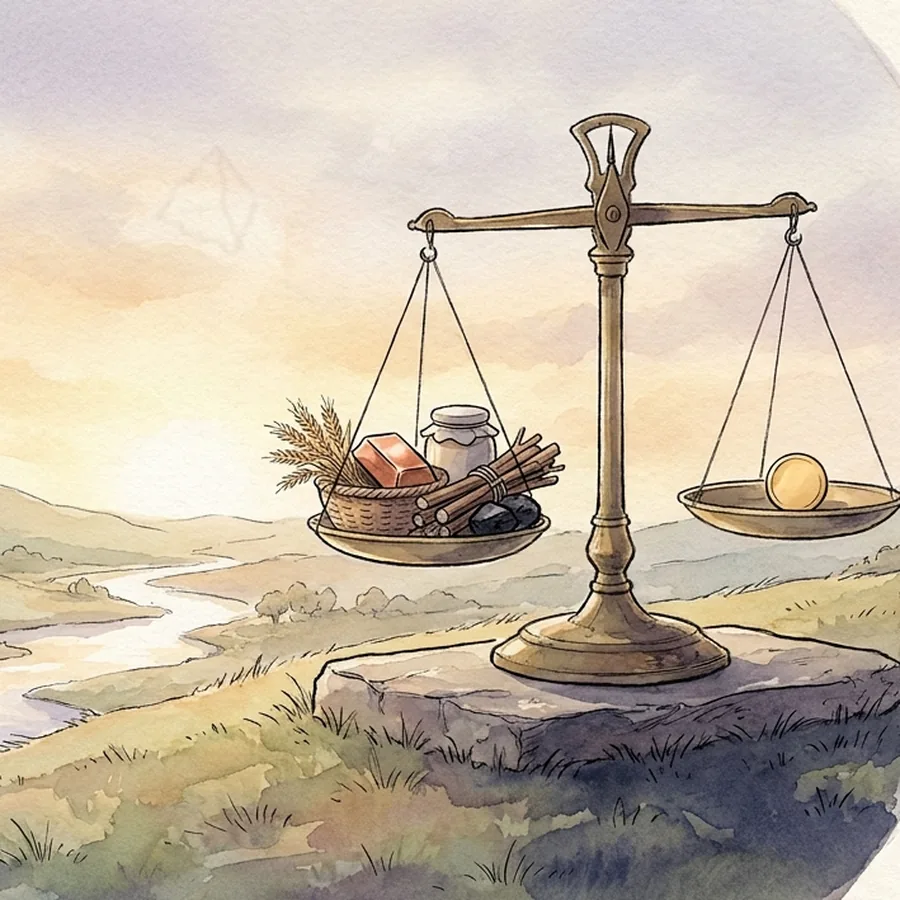
The Lydian · a measure, not a coin
Value you can check for yourself.
The Lydian measures productive capacity for the Reserve. It is not a coin you trade. It is denominated against a published basket of real-world commodities, so policy cannot inflate it away. Where fiat currency answers to a monetary authority's decisions, the Lydian answers to the basket itself. Its valuation is algorithmic and transparent, and anyone can check it.
That is what sound money means in practice: a unit of account that keeps its value over the same seven-generation horizon everything else here is built for, instead of one designed to erode a little every year.
Origin of the name
The Lydian Lion stater, struck around 600 BCE, was among the first standardized coins in history. It marked the first time a civilization decided a coin's value should be trustworthy on its face, wherever it traveled. The Lydian carries that idea forward.
Price of record
The Lydian's price of record is computed from its basket by an oracle. It is designed so that both the number and the method behind it can be inspected.
The Regenerative Wealth Reserve
A reserve that funds the work, and grows through what it funds.
The Reserve is a long-horizon capital base: global in idea, with a lawful local expression in each jurisdiction where it operates. It funds the identity infrastructure, the MicroCities and the education that prepares the next generation to steward both.
 Financial Money, assets and the returns they earn.
 Ecological Land, water, soil and the living systems on them.
 Cultural Language, craft, memory and a people's ways.
 Social Trust, kinship and the ties that hold a place together.
 Generational What is left for the children's children.
What makes it regenerative is the accounting. The five capitals are weighed together. A project that earns a financial return by depleting ecological or cultural capital does not register as a net gain. The Reserve is not an investment fund: it takes no deposits with minimums, tiers or pledge-back structures. It is denominated in the Lydian.
"Money is belief made tangible."
The Currency Code